A messy dresser turns into neat rows when you fold your clothes on edge and install a drawer divider to keep every shirt and pair of pants in place.
How to organize dresser drawers that are always a mess
Written up by Margo Lockridge
6 minutes to read

A dresser drawer turns into a heaped mess when flat-folded clothes stack up and collapse. You can stop the cycle by folding your clothes to stand on edge and locking them into neat rows with a drawer divider.
Pull everything out to see what you actually wear
Open the worst drawer and dump the entire contents onto your bed. Doing this forces a decision on every piece. Sort the pile into things you wear regularly, items you need to donate and pieces ready for the trash bag. Set aside any garments with broken zippers or permanent stains.
Emptying the drawer completely also reveals hidden dirt and lint trapped in the corners. Wipe the bare wood down with a damp cloth and let it dry completely before you put anything back.
Count the clothes you are keeping to figure out exactly how much storage space you need. A drawer packed tight with heavy sweaters needs a different layout than one holding a few thin shirts.
Moving out of season items to a closet packed to the door clears up room in your daily dresser. Keep only the clothes you wear right now in your main drawers.
Give every dresser drawer a single dedicated job
A drawer descends into chaos when shirts mix with heavy pants and stray socks. Assigning one clothing category to each drawer speeds up your morning. You reach for the right item without rummaging through folded stacks.
Match the volume of the clothing category to the size of the drawer. Shallow top drawers are built for small, loose items that get lost in deep spaces. Large, deep bottom drawers are built to hold the bulk of heavy winter wear and stiff denim.
Designate the top tier for socks, underwear and small accessories. Give the middle sections to daily shirts, light sweaters and shorts. Bottom drawers hold thick jeans and bulky sweatshirts.
Keeping heavy clothes in the bottom drawers can make the dresser easier to open and close. That layout also makes putting fresh laundry away quicker.
Fold your clothes to stand on edge in clear rows
Flat stacks force you to lift the top shirts to see what sits at the bottom. Pulling a shirt from the middle drags the rest out with it. Clothes folded to stand upright like files in a cabinet show every item the second you open the drawer.
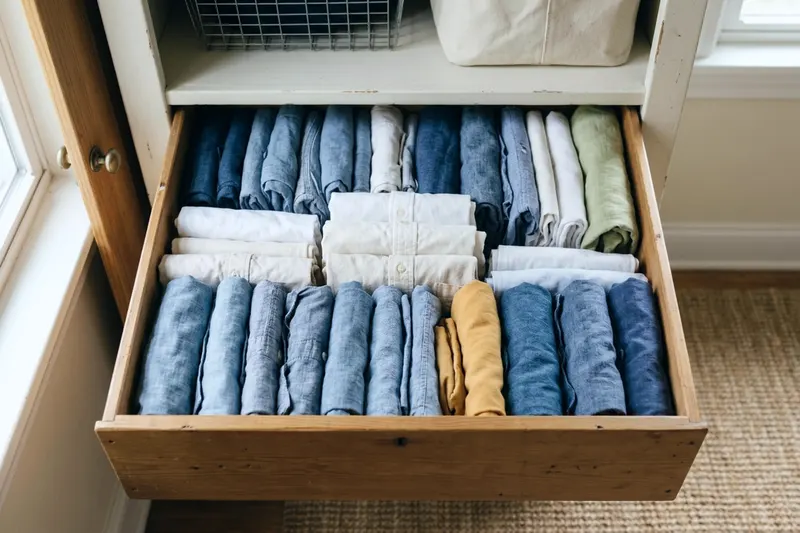
Lay a shirt flat on a table face down. Fold the left side across the middle and tuck the sleeve down flat, then repeat with the right side to form a long rectangle. Fold the bottom hem up to the collar, and then fold that bundle in half again so it forms a firm block.
The finished block should stand up on its own edge without flopping over. Place this folded block into the drawer with the folded edge facing the ceiling. You can now spot each shirt by its top edge and pull one out without disturbing the neighbors.
Pants take the same approach. Fold jeans in half so the back pockets touch, fold the crotch point inward to make a straight line, and bring the ankles up to the waistband. Fold the remaining length down repeatedly until the denim block stands upright.
Refold each shirt and pair of pants the same way when laundry comes out of the dryer so the rows keep their shape.
Measure the inside of the drawer before buying dividers
Dresser drawers look standard from the outside but vary on the inside. A dresser drawer organizer that sits too high will catch on the frame and jam the drawer shut. Dividers that sit too low allow folded clothes to spill over the top and mix together.
Take a tape measure and check the internal depth from the front panel to the back board. Measure the height from the bottom panel to the top rim of the drawer box. Write these dimensions down before you shop for any organizing inserts.
You also need to note the physical thickness of the drawer panels themselves. Some dividers clamp onto the edge of the wood, and a chunky antique dresser requires a wider clamp than a thin particle board frame. Taking accurate measurements helps you avoid buying hardware that bends or damages the wood.
A proper fit leaves a small gap between the top of the divider and the drawer opening, so nothing catches when the drawer is full of clothes.
Install a spring loaded drawer divider to hold long rows
Folded blocks of clothing fall over when they lack side support. A spring loaded drawer divider solves this by acting as a temporary wall that spans the full depth of the space. These inserts push against the front and back panels to lock firmly into place.
Look for spring loaded dividers that feature soft foam pads on both ends. The foam grips the wood so the divider stays put. You simply compress the spring, slide the divider in front to back, and release the tension to lock it down.
Place one divider on each side of your newly folded shirts to form a tight, structured row. The tension holds the clothes upright even when you pull a shirt out for the day.
You can adjust the width of these rows to match your clothing exactly. Wide winter sweaters get more space, while thin summer shirts get a narrow channel. If your wardrobe changes, compress the spring and slide the divider over to a new spot.
Use small open boxes for loose socks and underwear
Small items slip under long dividers and scatter into the corners. A dedicated sock drawer organizer built from small open boxes catches these loose pieces and creates rigid compartments. You can arrange these square and rectangular boxes in a grid that fills the shallow top drawers.
Choose soft fabric boxes that bend slightly to fit odd spaces, or rigid bamboo boxes that match the wooden interior of the dresser. An open underwear drawer organizer keeps delicate items from snagging on rough wood while making it easy to grab what you need.
Fold socks together and stand them on edge inside a small square box. Roll belts into tight coils and drop them into their own individual slots.
Arrange the boxes so they sit tight against each other and the sides of the drawer. If a gap remains at the back, fill it with an empty box so the front compartments cannot slide backward when you close the drawer.
Leave breathing room so the drawer slides easily
Packing a drawer to the absolute brim makes a future mess likely. Clothes crammed together wrinkle easily and bind up against the frame above. When you have to force a drawer shut, the friction pulls the top edge of your clothes into a tangled heap.
Leave empty space at the back of every row and a gap above the clothing line. This breathing room makes it easy to flip through your shirts and drop fresh laundry back into place. You should be able to slide your hand between the folded clothes and the back panel without any resistance.
Dropping worn items into a hamper right away stops them from finding their way back into the clean rows.
If you run out of room before you run out of clothes, you have to cull the pile again. Keeping a little empty space is the easiest way to keep an organized dresser drawer neat week after week.


